


Businesses, original equipment manufacturers (OEMs), and industrial specialists: flow sensors are important, indispensable even, for many industrial processes. They help you accurately measure the flow rate of substances and detect leaks or blockages.
Whether to optimize system efficiency, calculate fluid properties, or comply with regulatory environmental compliance audits, understanding the capacities, functions, and basic applications of the many flow sensor types on the market is crucial for monitoring, controlling, measuring, and verifying processes across a variety of industries.
If you’re looking for a quick overview of the different types of flow sensors on the market, we’ve got you covered. In this brief article, we’ll walk you through 10 of the most popular and useful flow sensor types, so you can make more informed decisions for research and product development, and much more.
Join us as we explore 10 of the most popular flow sensor types on today’s market.
A word on the applications of flow sensors
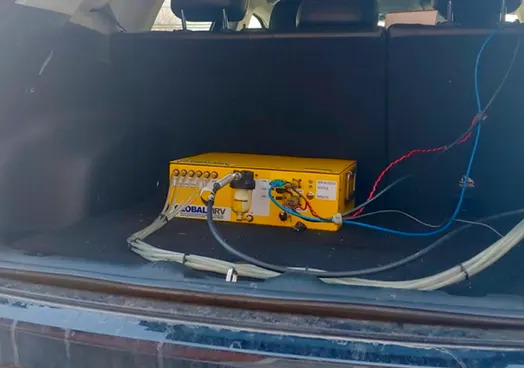
Before jumping into our top 10 list of flow sensors, we just want to note that each flow sensor is tailored for different use cases. Keep in mind that we’ll help differentiate between their functionalities and forms, as well as understand how they apply in different industries and niches.
10 types of flow sensors (and how flow sensors work)

| 1. Differential pressure sensors 2. Optical flow meters 3. Vortex flow meters 4. Turbine flow sensors 5. Ultrasonic flow sensors 6. Positive displacement flow sensors 7. Coriolis flow meters 8. Magnetic induction flow sensors 9. Thermal flow sensors 10. Mass flow sensors |
1. Differential pressure sensors
First, we have differential pressure sensors. These sensors operate by relating air or fluid velocity to pressure. They use flow constriction to cause a pressure drop in the device.
Operators use differential pressure sensors to measure the pressure difference before and after a moment of constriction to determine the flow rate of gas or fluid. Also, differential pressure sensors are often used in air conditioning and heating systems.
You’ll find differential pressure sensors in HVAC systems because they help regulate air and fluid flow for heating and cooling purposes. But differential pressure sensors can also be used in manufacturing and pharmaceutical production.
As a whole, differential pressure sensors are used to monitor air and liquid flow rates to help engineers and product development teams better regulate the dose and quality of their product.
2. Optical flow meters
Optical flow meters use non-contact measurement techniques to analyze scattered light patterns from particles within fluids or gases. Using precise and sensitive laser and LED light beams, these sensors are ideal for avoiding fluid contamination.
You’ll find optical flow meters in a variety of different sectors, such as pharmaceuticals, manufacturing, biomedical research, computers, and semiconductor creation.
3. Vortex flow meters
With vortex flow meters, a blunt object is placed inside an area to help separate the flow of a fluid, vapor, or gas. What’s more, vortex flow meters measure the flow rate by detecting vortices shed from the object.
The flow rate is calculated by looking at the frequency of these vortices, which are proportional to the velocity of the matter that’s coming in contact with the object.
Chemical and gasoline processing, water treatment, and energy management systems often use vortex flow meters for emissions monitoring and reporting.
4. Turbine flow sensors
Another common flow sensor type is the turbine flow sensor. These sensors use a rotating turbine that comes into contact with the gas or fluid flow. In fact, the speed of the turbine is proportional to the flow rate.
Lastly, this type of sensor is often used for gas, chemical, and pharmaceutical applications.
5. Ultrasonic flow sensors
Ultrasonic flow sensors deal with ultrasonic pulses. They analyze how long pulses take to travel up or down in a flow path. Mostly, ultrasonic flow sensors measure fluids.
Generally, two main types of ultrasonic flow sensors exist:
- Transit-time ultrasonic flow sensors: Transit-time sensors measure the time between sound waves traveling with and against a flow.
- Doppler sensors: Doppler sensors measure shifts in frequency within the particles in the substance measured.
Also, you’ll often find ultrasonic flow sensors used in water and waste management, in addition to oil and gas industries.
6. Positive displacement flow sensors
By the description of the name, positive displacement flow sensors, or positive displacement (PD) meters (such as oval gears, pistons, and nutating discs), work by flowing fluid mechanically displacing fixed-volume chambers or elements that rotate and/or count cycles.
These flow sensors often fill and empty fluid into a system that contains a sensor that helps measure how much the pre-existing content has been displaced. Flow rate data is then analyzed and provided to the user.
Many applications that require high accuracy, such as metering liquid flow, often use positive displacement flow sensors.
7. Coriolis flow meters
One of the many applications of flow sensors is the way in which objects curve. The Coriolis effect explains how objects appear to move in a curved path due to the Earth’s rotation at different speeds.
Coriolis flow meters use tube vibration and oscillation to create relative motion in a non-inertial frame. The deflection calculated is due to Coriolis acceleration on the fluid mass.
In addition, Coriolis flow meters are commonly used to measure the flow of substances involved in chemical processing, the food and beverage industry, and pharmaceutical drugs.
8. Magnetic induction flow sensors
Magnetic induction flow sensors measure the flow rate by detecting the voltage generated by conductive liquids that pass through magnetic fields. Also, these flow sensors are often used in water treatment and chemical processing facilities.
These sensors are designed to be larger than most flow sensors, and they’re widely used to improve overall system performance for a number of applications.
9. Thermal flow sensors
Thermal flow sensors measure heat in a liquid or gas to help determine flow rate. The difference between the upstream and downstream temperatures of an object is measured.
At zero flow, the temperatures are equal. As the flow increases, more heat is detected downstream.
At higher rates, the power supplied to the heater varies to better maintain a fixed temperature difference between the two sensors. The power level is converted to flow rate by the internal electronics.
A single element is used to heat the probe and measure temperature. What’s more, increased airflow leads to more heat being dissipated from objects.
Thermal flow sensors detect shifts in the temperature profile as air and gas flow through the sensor. Also, many thermal flow sensors measure air velocity and mass flow.
10. Mass flow sensors
Last but not least, we have mass flow sensors. To start, these sensors quantify the mass of air or gas that moves through a system.
Nevertheless, mass flow sensors provide accurate and reliable flow measurements for industries like the automotive industry to better understand how industrial air pollution from heavy-duty vehicles affects our health.
Also, mass flow sensors are used on typical consumer goods as well. Did you know that mass flow sensors are used for air purifiers as well as medical devices like inhalers?
For example, our Axion™ R/S portable emissions measurement system (PEMS) helps measure mass-flow emissions of carbon monoxide (CO), carbon dioxide (CO₂), nitrogen oxides (NOx), and hydrocarbons (HC) in real time for field and mobile emissions, engine, and performance analyses for more informed decision-making.
In summary, mass flow sensors are suitable for a wide variety of applications with liquids and gases.
Bonus: Target (drag-force) flow meters
Finally, our last type of flow sensor is the target flow sensor. With these sensors, a target plate is placed in a liquid stream. A target flow meter helps detect the target’s position.
Also, the flow of the fluid exerts a force on the target, which then moves in relation to the speed of the flow. Target flow meters, which uses a target plate or deflector where the force acting on it is proportional to the flow rate, operates under low pressure and is capable of handling solids and viscous fluids. .
Finally, you’ll often see target flow meters in projects that involve measurements and verifications of viscous liquids or fluids with suspended particles.
The importance of sizing and configuration in common flow sensors
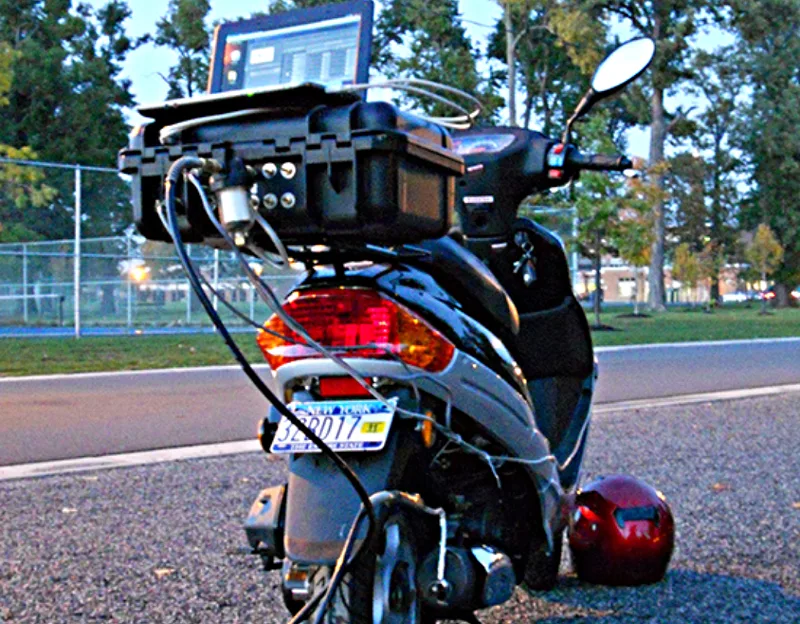
Of the many frequently asked questions we receive, we often are asked, “Do the sensors come in different sizes and configurations? Or, does a standard size exist for each sensor type?”
The good news is that each sensor type is available in different sizes and configurations. For example, many of our portable emissions measurement systems (PEMS) are large enough to measure the emissions outputs of large locomotives.
Similarly, our mini PEMS can measure the emissions output of smaller mechanical equipment like chainsaws or lawnmowers
What’s more, our Axion™ R/S+ has a proprietary algorithmic calculation that matches the performance of mass flow meters. We obtain the flow rate through the data collection and analysis process in the Axion R/S+’s system software.
Finding the right-sized sensor types is key to ensuring the density, thermal mass, flow range, and proper consistency of different gases and fluids. Your local sustainability consultant can help you find the right sensor for your industrial operation. Don’t hesitate to reach out to them should you have any questions about flow sensors.
Did you know?
Did you know that flow sensors can be used to measure the real driving emissions of vehicles, like Jeeps, in rugged terrain? You can receive real-time data on your Jeep’s performance with the help of equipment that uses flow sensors.
Check out what information our flow sensors gathered in one of our jeeps in upper state New York in our Instagram reel here.
Need troubleshooting for your flow sensor application?
If you’re looking for flow sensors to measure liquids or gases used in industrial processes, you couldn’t have picked a better time. Recent market data suggests the market for flow sensors is projected to expand over the next five years, so you’re in luck.
Looking for help with choosing the right flow sensing element and product for your operation? Need a device that helps measure elements in abnormal flow conditions?
We can help!
What’s more, our portable emissions measurement devices (PEMS) can run more than 60 different types of diagnostic testing regimes and support over 100 different apparatuses for overall emissions reduction and fuel calibration testing.
To learn more about the versatility of our PEMS devices and how they can help support your flow, don’t hesitate to contact us. We look forward to helping you grow and achieve results.