


Perhaps you’ve needed measurement devices for colors before. Perhaps you work in an industry that needs to measure infrared wavelengths using spectroscopy. Either way, you’ve probably heard of spectrometers and spectrophotometers.
But what’s the difference between spectrometers and spectrophotometers? And, how are they similar?
Knowing the difference between the two is key to ensuring you receive the right measurements for your operation. Wondering what the difference is between the two?
Our sustainability consultants have you covered.
In this article, we’ll discuss spectrometers versus spectrophotometers, specifically:
- What a spectrometer and spectrophotometer are
- The similarities and differences between the two
- How spectrometers and spectrophotometers can be included in equipment that supports environmental pollution mitigation
- The value of choosing a knowledgeable and expert sustainability consultant for product testing
Similarities and differences between spectrometers and spectrophotometers
| Spectrometer | Spectrophotometer |
| 1. A spectrometer analyzes light by separating the light into wavelengths. 2. Spectrometers don’t always need a sample to operate. 3. Spectrometers are often used in physics, optics, astronomy, and materials analysis. | 1. A spectrophotometer measures the absorbance of transmittance of light. 2. A spectrophotometer always needs a sample. 3. Spectrophotometers are often used in chemistry, biology, environmental testing, and lab testing. 4. Spectrophotometers contain a spectrometer. |
What exactly is a spectrometer?

A spectrometer is a device that allows you to detect and analyze a substance’s light waves to measure its physical characteristics over a range or spectrum. As such, different types of spectrometers exist.
Three of the most common spectrometers include:
- Optical spectrometers
- Nuclear magnetic resonance spectrometers (NMR)
- Mass spectrometers
Optical spectrometers measure light properties from an electromagnetic spectrum, whereas NMR spectrometers are used by chemists, biochemists, and other physical science professionals to explore organic molecule properties.
As such, mass spectrometers are used to determine the mass of various molecules in a substance.
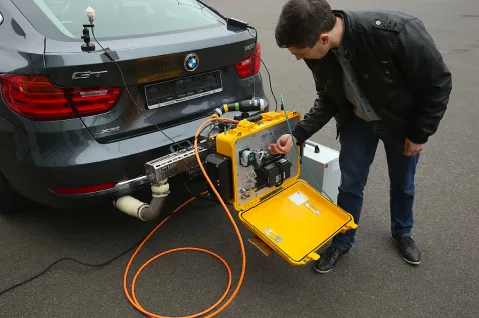
For example, we use spectrometry-based technology to help measure the mass and make-up of primary and secondary pollutants emitted from internal combustion engine-powered equipment. In particular, our line of vehicle emissions testing equipment, Axion R/S, uses state-of-the-art spectrometry to help measure the chemical makeup of exhaust emissions for more refined product development.
The extent to which spectrometers are used spans across a variety of industries and processes. Like spectrometers, spectrophotometers can be used to help with measuring wavelengths across a variety of processes.
What exactly is a spectrophotometer?
Similar to spectrometry is spectrophotometry, a method of measuring how much a substance absorbs light. As mentioned previously, spectrometers measure the reflection or transmission of light by objects, usually in wavelengths that range from 360 to 760 nanometers (nm).
As such, spectrophotometers measure the full color spectrum. They help produce data about the spectrum of colors in the world that’s not detected by the human eye.
Spectrophotometers allow us to test colors against standards to ensure the colors adhere to a product’s specifications. These devices can also be used to test other properties of color, such as:
- Measuring color and how color forms
- Metamerism, which is the concept that the human eye observes two colors that appear the same under one light, but look different under a different light
- Measuring the opacity and haze of a color
- Detecting the presence of impurities
Spectrophotometers can be used in a variety of applications and industries. For example, spectrometry and spectrophotometry can be used to identify impurities in the gasoline that an internal combustion engine uses.
Engineering teams can use a spectrometer and spectrophotometer to determine the concentration of various substances to smarter choices for engine development and research.
From materials manufacturing to chemical testing to pharmaceutical and lab testing, industry professionals rely on spectrophotometers to accomplish a variety of industrial processes.
Key differences between a spectrometer versus a spectrophotometer

The largest difference between a spectrometer and a spectrophotometer is that a spectrometer measures radiated light matter, while spectrophotometers measure the color that said light matter produces.
A spectrometer is used in a variety of analytical investigations, while spectrophotometers are systems that contain a light source. Spectrophotometers provide a means to collect light that has interacted with the subject or product in question.
In other words, all spectrophotometers contain spectrometers, but not every spectrometer contains a spectrophotometer. Spectrometers measure radiated matter from light, whereas spectrophotometers measure the color said matter produces.
Similarities between a spectrometer and a spectrophotometer

Both spectrometers and spectrophotometers are used to measure, identify, and quantify specific wavelengths and color measurements.
Both instruments are designed to measure spectral data and light across a range of wavelengths. In fact, both instruments measure light in nanometers, and both measure the resolution, sensitivity, stability, and stray light of a substance.
Also, both spectrometers and spectrophotometers are extremely helpful for analyzing samples, as you can study particle interactions, the composition of infrared light, and colorimetry involved with different substances.
Tips for reducing our carbon footprint with spectrometers and spectrophotometers
At the end of the day, when you’re trying to monitor and reduce your carbon footprint on the world, you need business strategies that help you track and minimize the size and distribution of harmful chemicals in the particles that your vehicle emits. Consider the following tips as part of your overall business strategy for reducing your operation’s carbon footprint:
- Prioritize key data: Establish sustainability goals based on accurate data about product emissions, your operation’s carbon consumption, and your product’s maintenance needs.
- Consider using industry-leading technology: Implement management software to monitor and analyze emissions in real-time.
- Be flexible: While spectrometers are a significant part of reducing emissions, businesses need to be flexible and approach research and development with a keen focus on environmental stewardship.
For more helpful information about reducing your carbon footprint using spectrometry, spectrophotometry, and other greenhouse gas measurement devices, check out our Instagram.
Need a device that measures electromagnetic radiation and particle outputs?
Spectrometers and spectrophotometers can help. Spectrometers and spectrophotometers measure the light intensity of different wavelengths.
Given that various industries often rely on the transmittance and absorption of ultraviolet (UV) light at the molecular level to ensure a more optimal product, color measurement devices like spectrometers and spectrophotometers are key to improving product research and development.
If you’re looking for a device that measures the composition of vehicle emissions, a spectrometer or spectrophotometer can help. Nevertheless, our portable emissions measurement devices (PEMS) use Tunable Diode Laser Spectrometry to measure the composition of various particles in internal combustion engines (ICE) to make more informed decisions for product development.
We’ve also developed accessories which can be used to quantify the composition of substances for a more sustainable operation. If you’re curious to learn how to make your operation more sustainable, we invite you to reach out to our team of Ph.D. researchers, managers, analysts, engineers, and technicians.
We’ve run more than 60 different types of diagnostic testing regimes and supported over 100 different vehicles and engines for overall emissions reduction and fuel calibration testing.
To learn about how spectrometry can be used in your industry, for fuel calibration testing and emissions reduction, contact us today.
Keep Your Operation Clean and Green
It’s All Possible with GlobalMRV